
For RS-485 communication, the most recommended cable is the shielded twisted pair, which is the best option for applications in environments with high levels of electromagnetic interference (EMI). The construction of this cable model prevents the effects of electromagnetic interference, which can cause signal distortion and lead to data acquisition failures, becoming a source of false alarms and compromising data integrity.
For standard RS-485 communication, without specific environmental constraints, different cables can be used without compromising the protocol's operation.
A twisted pair cable consists of two metallic conductors, insulated from each other and twisted along a common longitudinal axis with a specific twist pitch.
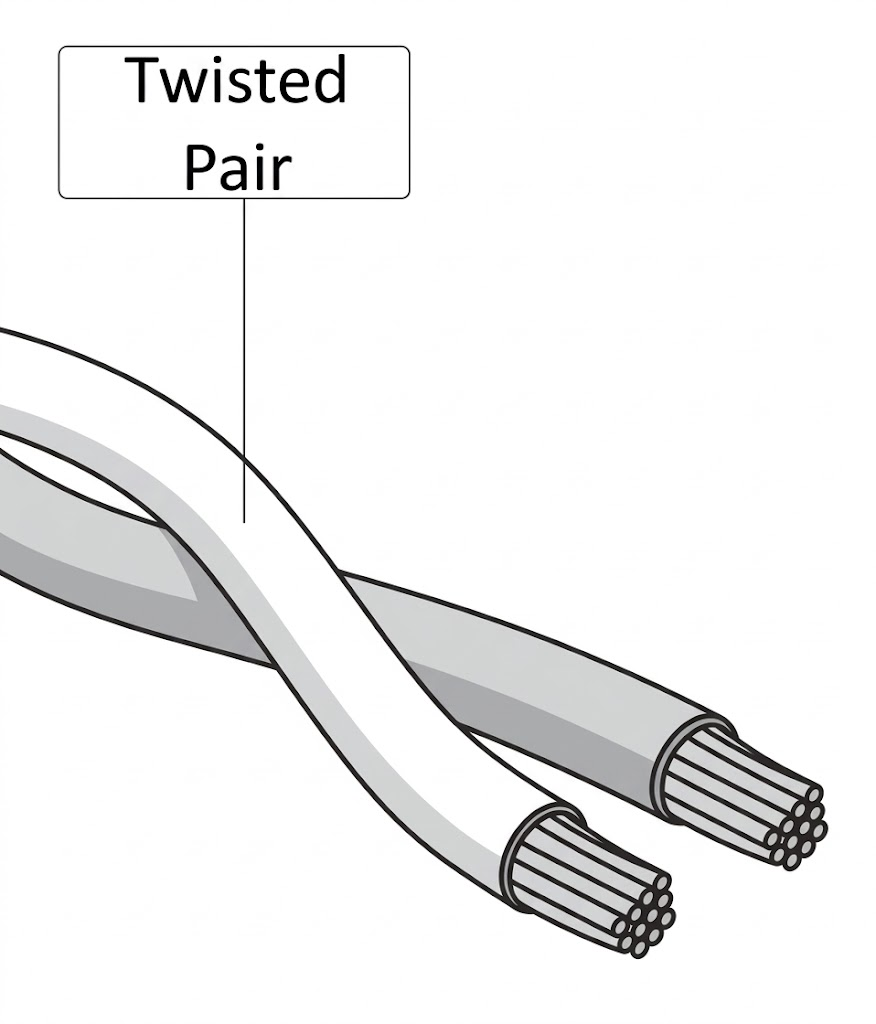 |
Figure 1 - Representation of a twisted pair cable. |

Information!
This arrangement improves immunity to electromagnetic disturbances, as the twisting forms a series of successive loops with alternating orientations. In this way, any magnetic field present in the environment passes through the pairs of loops in opposite directions, drastically reducing its impact.
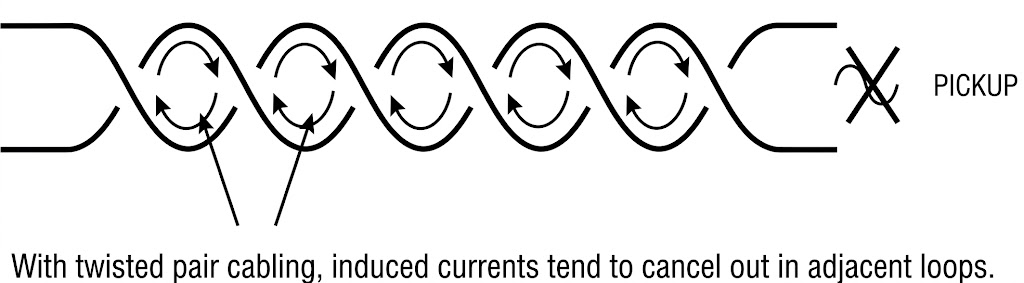 |
Figure 2 - Representation of electric field cancellation due to successive loops. |
The cable shielding corresponds to the metallic layer surrounding the twisted conductors. It can consist of a braided mesh of interlaced filaments or a thin metallic foil wrapped around the wires, and it may or may not include a drain wire - that is, a bare wire designed to facilitate the grounding of the shield. Both types serve equivalent functions and can be combined for optimal results, leveraging the best characteristics of each construction.
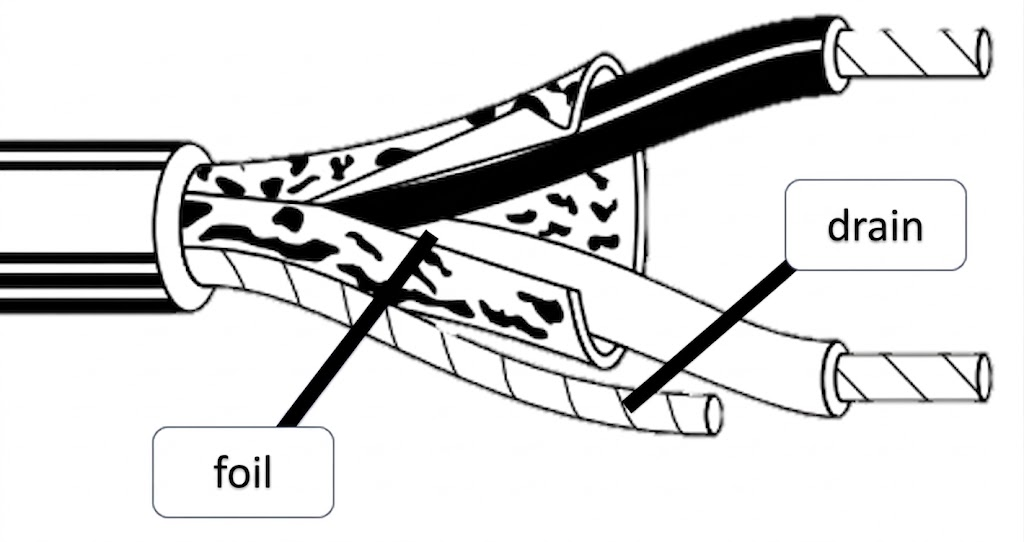 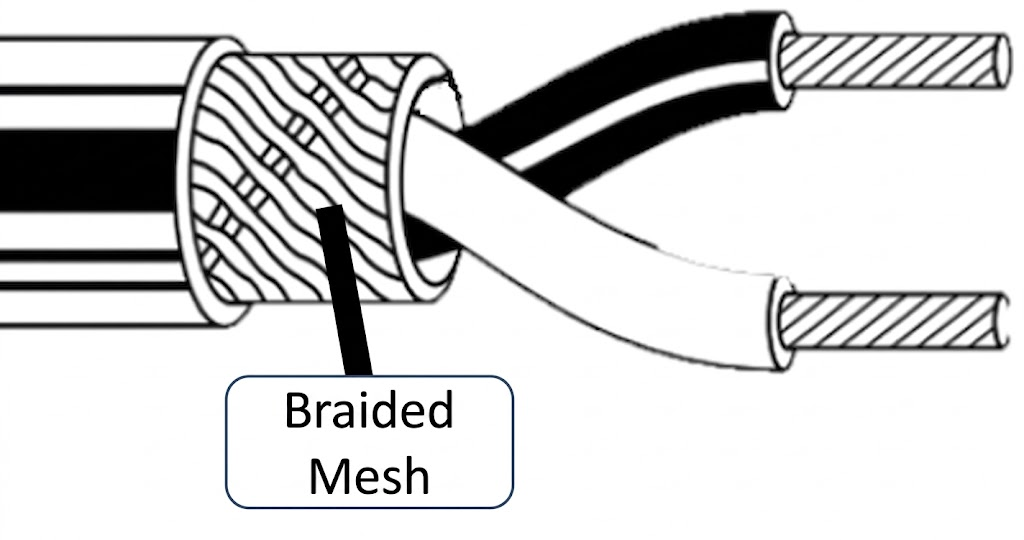 |
Figure 3 - Representation of shielding types in twisted pair cables. |
Information !
This arrangement acts as an electrostatic shield, ensuring that the presence of electric and magnetic fields inside the cable is minimal to none. This guarantees that the transmitted digital signal does not suffer from noise interference capable of causing substantial degradation to its integrity.
Characteristics
Flexible tinned copper conductor;
18 AWG (~0,8 mm² cross section);
Maximum length of 1200 m;
Nominal impedance of 120Ω;
Twisted pitch50 to 75 mm;
Insulation voltage of 300 Volts;
Operating temperature of -40 °C to +75 °C;
PVC jacket;
Shielding:
Braided mesh (70% to 95% coverage);
Aluminum foil + braided mesh is highly recommended;

Warning !
The choice of the most appropriate shielding type will depend on the level of electromagnetic interference (EMI) present in the installation environment.
Contact !
 Whatsapp(CSR):
 +55(11)91234–5678
 e-mail:
  Whatsapp(Network):
 +55(11)93096–4689

Was this article helpful?
That’s Great!
Thank you for your feedback
Sorry! We couldn't be helpful
Thank you for your feedback
Feedback sent
We appreciate your effort and will try to fix the article